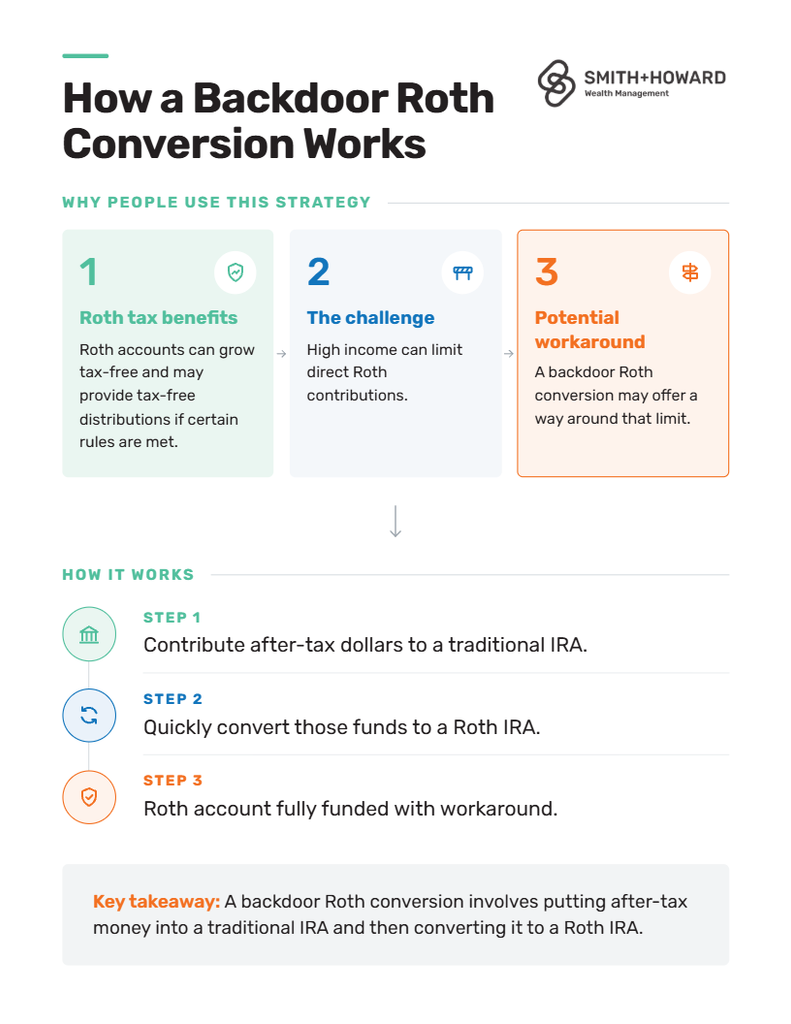
A backdoor Roth conversion is a multi-step strategy that lets high-income earners fund a Roth IRA even when their income exceeds the limit for direct contributions. Roth accounts can grow tax-free and provide tax-free distributions if you meet certain rules; because high income can limit direct Roth IRA contributions, a backdoor Roth conversion can offer a workaround.
How does a backdoor Roth conversion work?
The process has two steps. First, you contribute after-tax (nondeductible) dollars to a traditional IRA. Then you immediately convert those funds to a Roth IRA. It’s best to convert the after-tax funds to the Roth IRA immediately to avoid any earnings (interest) on after-tax dollars, since those earnings would be taxable.
What is the pro-rata rule, and why does it matter?
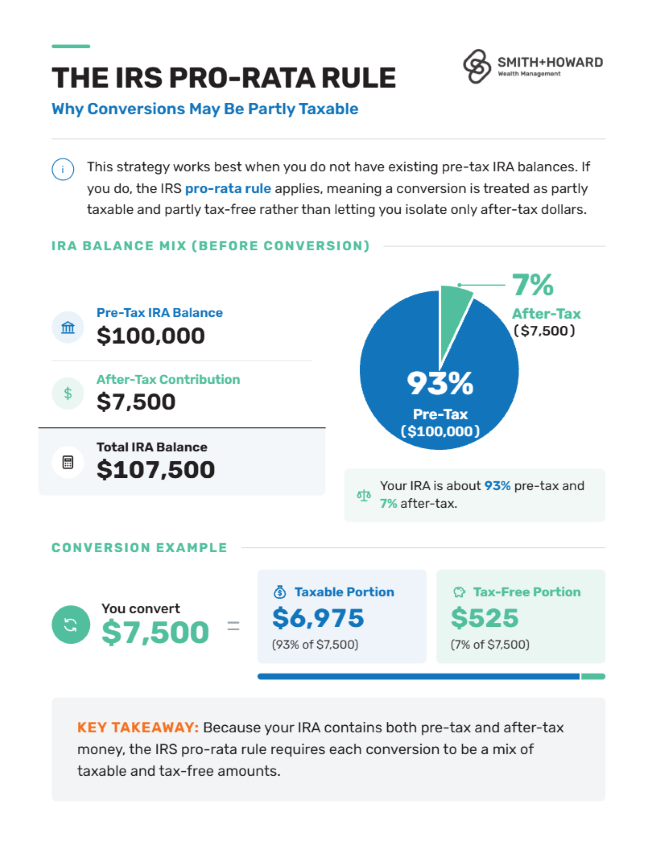
This strategy works best when you do not have existing pre-tax IRA balances. If you do, the IRS pro-rata rule applies, meaning the IRS treats a conversion as partly taxable and partly tax-free rather than letting you isolate only after-tax dollars. For example, if you have $100,000 of pre-tax IRA money (across all traditional IRAs per investor) and add a $7,500 after-tax contribution, the IRA is about 93% pre-tax and 7% after-tax. A $7,500 conversion would make roughly $6,975 taxable and $525 tax-free.
What else should you consider before a backdoor Roth conversion?
Contribution limits: This strategy does not increase the annual IRA contribution limit.
Tax reporting: Track after-tax basis on IRS Form 8606.
Timing: Prior-year IRA contributions are generally due by April 15; conversions are reported in the year completed.
Irrevocability: Roth conversions generally cannot be undone.
Pre-tax IRA balances: Consider whether those assets can be rolled into an employer plan, if allowed. This would move pre-tax money out of your IRA and allow a backdoor Roth conversion. Many factors need to be considered before taking this route; consult an advisor before proceeding.
Is a backdoor Roth conversion right for you?
A backdoor Roth conversion is not a one-size-fits-all strategy. Before deciding whether it makes sense, evaluate your broader financial situation. In some cases, other priorities may come first, such as funding an HSA, paying down high-interest debt, building an adequate emergency fund, or taking full advantage of an employer match in a 401(k). Context matters. Before moving forward, consult with a qualified financial advisor or tax professional to determine whether a backdoor Roth conversion is appropriate for your situation.
Frequently Asked Questions
Is a backdoor Roth conversion legal?
Yes. It is a permitted strategy under current tax law. Proposals to restrict it have surfaced in Congress in prior years, so it’s worth revisiting the approach with your advisor each year rather than treating it as automatic.
Does the pro-rata rule count my 401(k) balance?
No. The pro-rata calculation looks only at IRA balances — traditional, SEP, and SIMPLE — not employer plans such as a 401(k) or 403(b). That is why rolling pre-tax IRA money into an employer plan, if the plan allows it, can clear the way for a cleaner conversion if it makes sense.
What happens if I skip Form 8606?
Without it, the IRS has no record of your after-tax basis, and you could end up paying tax twice on the same dollars when you convert or withdraw. File it for every year you make a nondeductible contribution or complete a conversion.
Talk with an Advisor
To discuss whether a backdoor Roth conversion fits your retirement and tax plan, contact Michael Mueller and the Smith + Howard Wealth Management team today or call 404-874-6244.
Want to get insights right to your inbox?
Subscribe to our newsletter to get inside access to timely news, trends and insights from Smith and Howard Wealth Management.
 November 4, 2026
 Back to Insights